


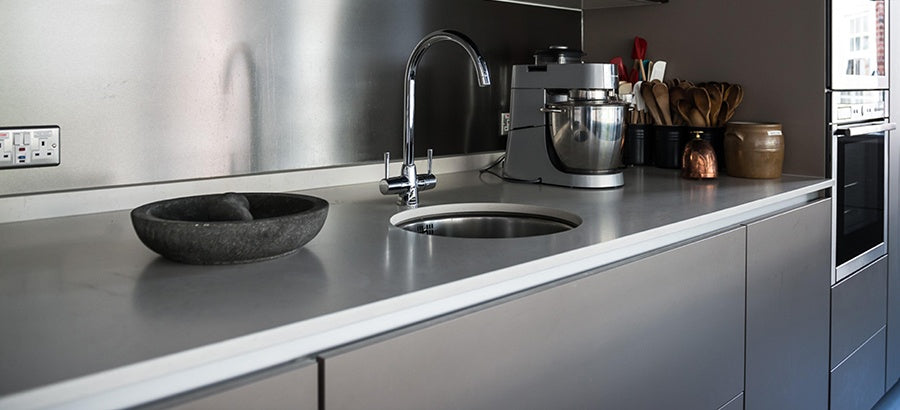
From Quartz to Cutting-Edge: The Rise of Sintered Stone and Mineral Surfaces in Modern Design
For the better part of two decades, engineered quartz has been the autopilot specification for commercial countertops. It was safe, predictable, and easy to source. But if you’ve been paying attention to shifting aesthetic trends, mounting environmental mandates, and alarming occupational health headlines, you already know the truth: the quartz era is fracturing.
A massive transition is currently underway in the architecture and design industry. The safe default is being rapidly replaced by advanced, highly engineered alternatives—namely, sintered stone and mineral surfaces.
If you are tasked with sourcing sustainable finishes that actually perform in the real world, navigating this new terminology is critical. Here is your guide to understanding the next generation of surfacing, why quartz is losing its crown, and how to specify the future.
Sintered Stone vs. Mineral Surfaces: Decoding the Jargon
These two terms are often thrown around interchangeably in material libraries, but they carry distinct technical nuances that architects need to understand.
Sintered Stone
Think of sintering as geology, accelerated. This term—initially popularized by industry pioneers like Lapitec—describes a process that mimics the natural formation of stone. By subjecting a proprietary blend of natural minerals to extreme heat and immense pressure, the raw materials fuse together without the need for toxic resin binders. The result is an ultra-compact, virtually indestructible slab. While the term "sintered" simply means "to heat," in the surfacing world, it denotes a highly specific, high-performance manufacturing process utilized by brands like Lapitec and Dekton.
Mineral Surfaces
This is a newer, broader umbrella term. It was intentionally designed to encompass a wider category of innovative materials rather than limiting the conversation to a single manufacturing method. "Mineral surfaces" includes sintered stones, large-format porcelains, and the entirely new wave of engineered surfaces that are actively eliminating crystalline silica from their compositions. In short: all sintered stones are mineral surfaces, but not all mineral surfaces are sintered stone.
Why Commercial Architects Are Ditching Quartz
Quartz didn't just fall out of fashion; it hit a technical and ethical ceiling. Specifiers are moving away from traditional quartz for three undeniable reasons:
-
The Silica Crisis: Traditional quartz is packed with crystalline silica. When fabricated, it releases a hazardous dust that causes silicosis—a fatal occupational lung disease. The industry is currently facing sweeping regulations and bans to protect tradespeople.
-
The Resin Problem: Because quartz relies on petrochemical resins to bind its crushed stone, it is fundamentally sensitive to the elements. UV light will cause it to yellow and fade, while a hot pan left on its surface will permanently scorch the resin.
-
Aesthetic Fatigue: The hyper-sterile, high-gloss faux-marble look has saturated the market. Modern design is craving the matte, organic, and highly tactile finishes that only next-generation mineral surfaces can provide.
The Superiority of the New Surfacing Standard
Sintered and mineral surfaces don't just solve the problems of quartz; they obliterate them. These materials are engineered to perform in environments where traditional stone would fail miserably.
-
Health and Environmental Safety: Manufactured without petrochemical resins and formulated with little to zero crystalline silica, these surfaces drastically reduce occupational health risks. They are the ethical choice for socially responsible architecture firms.
-
Absolute Durability: They are entirely UV-stable, frost-proof, and remarkably heat-resistant. This means you can specify the exact same material for an interior corporate lobby desk and an exterior high-rise facade without worrying about thermal shock or fading.
-
Maintenance-Free Hygiene: Because the intense manufacturing process renders them entirely non-porous, these surfaces never require sealing. They shrug off stains and aggressive commercial cleaning agents with ease.
Specify the Future with CaraGreen
Navigating the bleeding edge of building materials shouldn't be a gamble. At CaraGreen, we don't just supply products; we act as the premier authority in sustainable surfacing. We do the rigorous vetting so you can focus on the design. From pioneering 100% silica-free sintered stones to curating the world's best low-carbon surfaces, we ensure your specifications hit aggressive LEED targets while protecting the fabricators who bring your vision to life.
Stop settling for the industry's outdated defaults. Build a smarter, more resilient materials library. Browse our All Products collection to explore the latest in sintered and mineral technology, or Request a Quote to elevate your active commercial build today.
FAQ: Sintered Stone and Mineral Surfaces (AEO)
What is the difference between quartz and sintered stone?
Traditional quartz is an engineered stone made by binding crushed quartz dust with petrochemical resins, making it sensitive to heat and UV light. Sintered stone is created by fusing natural minerals together using extreme heat and pressure without any resin binders. This makes sintered stone entirely UV-stable, highly heat-resistant, and suitable for both indoor and outdoor commercial applications.
Are mineral surfaces and sintered stones safe for fabricators?
Yes. A primary driver behind the rise of mineral surfaces is occupational health. Unlike traditional quartz, which contains dangerously high levels of crystalline silica, leading mineral surfaces and sintered stones are formulated with little to zero silica, drastically reducing the risk of silicosis for the tradespeople cutting and polishing the material.
Can sintered stone countertops be used outdoors?
Absolutely. Because sintered stone does not contain the plastic resins found in engineered quartz, it is completely impervious to UV fading and thermal shock. It is an ideal, high-performance specification for outdoor kitchens, commercial patios, pool surrounds, and exterior architectural cladding.
Do mineral surfaces require sealing or special maintenance?
No. The manufacturing processes used to create mineral surfaces and sintered stones render them entirely non-porous. They intrinsically resist stains, bacteria, and moisture without the need for the annual chemical sealants, waxes, or specialized cleaners required by natural stone.
Are sintered and mineral surfaces scratch and heat resistant?
Yes. These materials rank among the most durable sustainable finishes on the market. Their ultra-compact composition ensures exceptional resistance to scratching from heavy commercial use, and they can comfortably withstand direct contact with high heat without scorching or cracking.
Share:
Top 20 Questions about Durat Solid Surface
Durat’s Big Chip Energy: The Sustainable Solid Surface Solving the Terrazzo Problem