


Let’s be honest: if your current business strategy relies on cutting the exact same 3cm basic white-veined quartz slab that a homeowner can order at a retail checkout counter between buying lightbulbs and mulch, you’re in trouble.
The rumors were true. Home Depot, Lowe’s, and Menards aren't just selling countertops anymore—they're buying the shops, building the plants, and taking the whole pie. While the corporate suits try to automate slab cutting into a low-margin race to the bottom, smart independent fabricators are pulling a fast one: abandoning commoditized quartz entirely and owning the high-margin, zero-silica hard surface market.
The Monopoly Move: How the Big Boxes Are Internalizing Fabrication
If you thought the big home improvement chains were going to stay friendly lead-generators forever, welcome to reality. Here is how they’re systematically cutting out third-party fabricators:
-
Home Depot’s Direct Play: Home Depot didn't just step into fabrication; they bought Construction Resources (CR). Through CR, they now own regional heavyweights like Ramos Marble & Granite, MVP Granite, and Vitoria. Translation? They import their own containers, cut in their own shops with W-2 employees, and collect the full markup.
-
Lowe’s & GableStone: After dropping $1.325 billion to acquire Artisan Design Group (ADG), Lowe’s quietly rolled out GableStone, LLC. GableStone isn't a third-party subcontractor; it’s Lowe's in-house, captive fabrication machine built to swallow retail cabinet programs and homebuilder contracts whole.
-
Menards & Midwest Manufacturing: Menards has been playing vertical chess for years. Through Midwest Manufacturing, they cut custom tops (CustomCraft Countertops®) in massive regional mega-plants, bypassing local independent shops and shipping finished tops straight to stores on their own fleet.
Attempting to compete with these multibillion-dollar logistics machines on basic engineered quartz is like trying to beat Amazon on paper towels. You will get squeezed on price, eaten alive on turnaround times, and left holding the bag on overhead.
The Silica Trap: Double-Whammy for Legacy Quartz
As if getting price-gouged by retail giants wasn't enough, traditional engineered quartz is facing a massive regulatory target. With Cal/OSHA emergency silica rules clamping down and national health authorities breathing down the neck of high-silica shop environments, cutting standard 90%+ crystalline silica quartz is becoming an insurance and liability nightmare.
So, why break your back and risk your shop's safety for a $3/sq. ft. margin on a commoditized slab?
The High-Margin Escape Hatch: Zero-Silica & Low-Silica Hard Surfaces
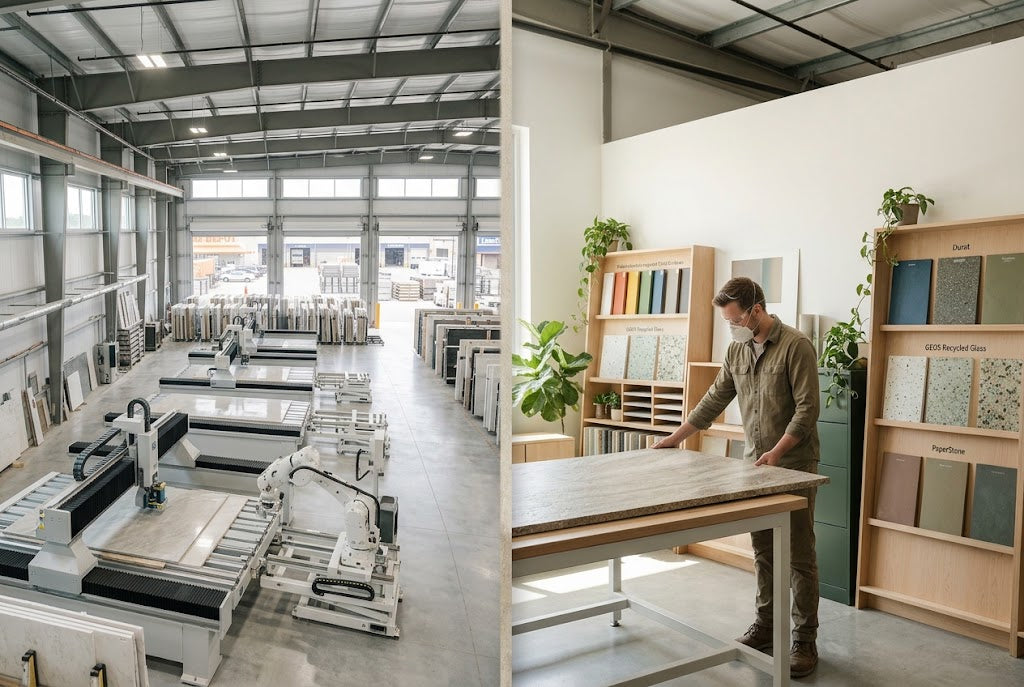
Automated big-box fabrication plants are built for one thing: mindless, repetitive throughput of standard 3cm slabs. They cannot handle high-touch design, specialized material hand-offs, or health-focused, specified hard surfaces.
By pivoting your shop toward zero-silica, low-silica, and high-performance hard surfaces, you escape the big-box price war and position yourself as the premium, health-conscious expert in your market:
1. Valiant CSF (Crystalline Silica-Free) Slabs
Why cut high-liability quartz when you can offer Valiant’s CSF line? Featuring 0% crystalline silica, Valiant CSF delivers over 30 high-definition, marble-inspired looks using breakthrough EcoPress and nano-ink printing. It cuts like luxury stone, resists scorches and scratches, and carries zero silica risk for your shop team.
2. Revolux 5D Mineral Surfaces
When clients want natural stone depth without the flat, synthetic look of basic quartz, Revolux Zero Silica Collection leads the way. Engineered with under 1% silica and built on recycled mineral bases, Revolux utilizes 5D nanotechnology printing to create hyper-realistic veining, extreme heat resistance, and lightweight handling.
3. Durat Post-Industrial Recycled Solid Surface
Zero silica, 100% recyclable, and made with up to 28% post-industrial recycled acrylic. Durat is the ultimate secret weapon for commercial specs (healthcare, higher ed, tech spaces) and custom residential vanities. It offers seamless joints, custom color matching, and no exposure to crystalline silica.
4. GEOS Recycled Glass and Gilasi Recycled Glass
Want an eco-chic visual that big boxes can't match? GEOS and Gilasi combine post-industrial recycled glass with durable binders, creating non-porous, stain-resistant hard surfaces with striking aggregate and no crystalline silica exposure. (glass is amorphous silica)
5. PaperStone Architectural Composite
Dense, stone-hard, and completely silica-free. Made from recycled paper and non-petroleum phenolic resin, PaperStone can be fabricated using standard heavy-duty woodworking tools. It provides a warm, tactile, matte aesthetic that high-end architects specify by name.
6. Porcelain & Sintered Stone Slabs
For clients demanding full indoor-outdoor UV stability, fireplace cladding, or extreme thermal resistance, porcelain slabs provide a zero-silica solution that big-box assembly lines simply don't necessarily have the craft skills to cut and install.
Material Portfolio Comparison: Commodity vs. High-Margin Independent
|
Hard Surface Category |
Representative Product |
Silica Content |
Big-Box Risk |
Margin Potential |
|
Commodity Quartz |
Basic Imported 3cm Slabs |
85%–93% Silica |
Extreme |
Razor-Thin |
|
Zero-Silica Slabs |
Valiant CSF Line |
0% Silica |
Low |
Premium |
|
Next-Gen Minerals |
Revolux Zero Silica Collection |
<1% Silica |
Low |
High |
|
Recycled Solid Surface |
0% Silica |
Very Low |
High (Commercial Spec) |
|
|
Recycled Glass |
Low/Zero Silica |
Low |
High (Design-Driven) |
|
|
Paper Composite |
0% Silica |
Very Low |
Specialty Niche |
|
|
Porcelain Slabs |
Porcelain / Sintered |
0% Silica |
Low |
Premium (High Craft) |
3 Moves to Outsmart the Big-Box Giants This Year
-
Fire the Commodity Slabs: Stop filling your showroom racks with generic white quartz that customers can price-match on their phones at Home Depot.
-
Lead with Shop Safety & Performance: Pitch homebuilders and A&D specifiers on the benefits of zero-silica options like Valiant CSF and Durat. In an era of heavy OSHA enforcement, offering safer, sustainable materials is a massive competitive flex.
Partner with Niche Hard Surface Distributors: Work with distributors who actually curate unique, specified, and health-focused hard surfaces—giving you the exclusive sample support, technical specs, and design pull you need to own your local market.
FAQ
Are Home Depot and Lowe's taking stone countertop fabrication in-house?
Yes, Home Depot and Lowe's are actively verticalizing countertop fabrication. Home Depot acquired Construction Resources (CR)—gaining ownership of Ramos Marble & Granite and Vitoria—while Lowe's acquired Artisan Design Group (ADG) and launched GableStone, LLC to operate internal, captive stone fabrication facilities nationwide.
What is Valiant CSF, and is it completely silica-free?
Valiant CSF (Crystalline Silica-Free) is a 100% zero-crystalline silica engineered hard surface slab collection. Manufactured with EcoPress technology and nano-ink printing, Valiant CSF replicates natural marble veining and MOHs 7 durability without the workplace health risks associated with crystalline silica dust.
How do Revolux mineral surfaces differ from traditional engineered quartz?
Revolux mineral surfaces are available with less than 1% crystalline silica in the Revolux Zero Crystalline Silica Collection, compared to traditional quartz, which contains 85% to 93% silica. Revolux uses 5D nanotechnology printing on a recycled mineral base, producing deeper natural stone realism, higher heat resistance, and lower silica exposure during fabrication.
What are the best zero-silica alternatives to engineered quartz countertops?
The top zero-crystalline silica hard surface alternatives include Crystalline Silica-Free (CSF) slabs like Valiant CSF, Caesarstone’s Icon line, Cosentino’s Eclose line and post-industrial recycled acrylic solid surfaces like Durat, recycled paper composites like PaperStone, recycled glass like GEOS and Gilasi and porcelain or sintered stone slabs.
How can independent countertop fabricators compete with big-box store prices?
Independent fabricators can compete with big-box stores by stepping away from commoditized engineered quartz and offering specialized, high-margin materials—such as zero-silica mineral slabs, porcelain, and sustainable composites—while providing custom design consultation, A&D specification support, and high-touch local installation.
Share:
So, How’s That Imported Quartz Working Out For You?