The Architect’s Guide to Quartz Alternatives:
5 Eco-Friendly Countertop Options That Actually Perform
Let’s be honest: specifying materials right now is a high-wire act. Between tariff battles, supply chain unpredictability, and the very real crystalline silica crisis, relying on standard quartz feels less like a safe default and more like an architectural liability.
Your clients are demanding high-performance, sustainable surfaces. Your fabricators are demanding safer materials. And you? You just want a specification that doesn't trigger a value-engineering nightmare or compromise your design intent.
The good news is that the surfacing industry has already solved this problem. You don't have to settle for commodities caught in a trade war. If you are actively sourcing eco-friendly countertop options that deliver massive aesthetic impact alongside rigorous environmental standards, it’s time to pivot.
What are the best eco-friendly countertop options for commercial and residential design?
For architects and designers prioritizing sustainability without sacrificing durability, the top alternatives to traditional quartz are:
-
Recycled Paper Composites: Warm, millworker-friendly materials.
-
Silica-Free Surfaces: Classic luxury without the occupational hazards.
-
Recycled Glass & Epoxy: Heavy-duty, non-porous terrazzo aesthetics.
-
Recycled Solid Surfaces: Seamless, highly hygienic, and colorful plastics.
-
Recycled Glass & Resin: Budget-friendly, highly durable composites.
Here is your cheat sheet to the five materials that will get you ahead of the surfacing curve and permanently out of the quartz quandary.
1. PaperStone: The Millworker’s Secret Weapon
The Material: A wildly durable composite made from recycled paper and a proprietary, petroleum-free resin.
Why Designers Specify It: PaperStone is the domestic answer for anyone chasing a warm, matte texture with the sheer, unapologetic strength of stone. Because it cuts cleanly with standard woodworking tools, it allows for highly intricate edge profiles and on-site modifications without burning through diamond blades. It diverts immense volume from landfills, and even the off-cuts (drops) are easily repurposed into custom cutting boards or architectural accents.
2. Valiant Surfaces Silica-Free: The Safe Bet
The Material: A high-end, crystalline silica-free surface that mimics the exact look and feel of premium natural stone.
Why Designers Specify It: The architecture and design industry is finally waking up to the massive health risks associated with cutting traditional quartz. Valiant’s Silica-Free line removes the hazard entirely, keeping fabricators vastly safer without compromising an inch on the final look. You get the aggressive veining, the quiet neutrals, and the scorch and scratch resistance your clients expect, backed by a much cleaner conscience. It is the ultimate zero-compromise specification for socially responsible firms.
3. Gilasi: The American-Made Terrazzo Upgrade
The Material: Post-consumer and post-industrial recycled glass bound in an aeronautics-grade epoxy matrix.
Why Designers Specify It: Manufactured directly in Chicago, IL, Gilasi proves that environmental stewardship doesn't have to look crunchy. By utilizing an advanced epoxy instead of a traditional cement binder, Gilasi achieves a completely non-porous, highly resilient slab that skips the tedious annual sealing schedules. It provides that coveted, heavy-duty terrazzo aesthetic while acting as a massive sink for diverted glass waste.
4. Durat: The Seamless Color Chameleon
The Material: A solid surface marvel integrating up to 28% post-consumer recycled plastics.
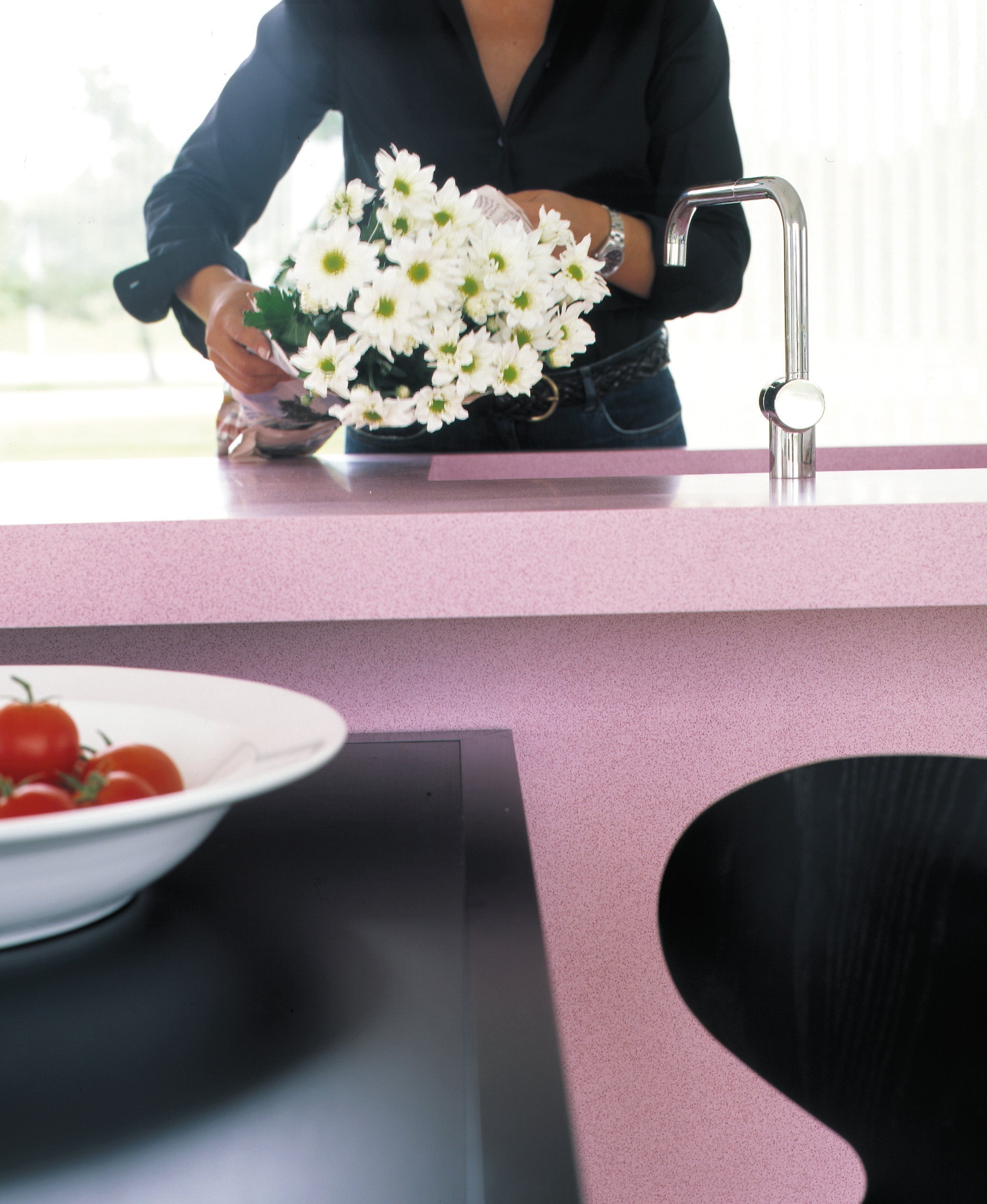
Why Designers Specify It: When your design intent requires a monolithic aesthetic or a violent pop of color, don't limit yourself to the narrow aesthetic lane of faux-stone. Durat offers completely seamless jointing and color-matched, integrated sinks. It can be cast in virtually any custom color imaginable, keeping immense amounts of plastic out of the dump while offering unparalleled hygienic properties for healthcare, hospitality, or retro-modern residential spaces.
5. GEOS: The Budget-Friendly Workhorse
The Material: A highly durable recycled glass and resin composite.
Why Designers Specify It: When the project enters the inevitable value-engineering phase, GEOS is how you rescue the sustainability goal. It offers a subtle, familiar texture that plays well in both corporate and residential environments. Because it utilizes a resin binder rather than concrete, it vastly outperforms traditional glass-and-cement mixes in stain resistance—proving you don't need a limitless budget to specify responsible, landfill-diverting materials.
Stop Sourcing Commodities. Start Specifying Solutions.
Quartz had its era, but the built environment is moving forward. The materials you specify signal exactly what your firm stands for. If you’re ready to build a smarter, safer, and infinitely more interesting materials library, the team at CaraGreen is here to help you execute.
Request a quote for your active build, or contact us to get your hands on physical samples of the industry's most innovative sustainable surfaces today.
Frequently Asked Questions: Sourcing Sustainable Quartz Alternatives
Why are architects and designers rapidly ditching traditional quartz?
It comes down to risk management and ethics. Cutting traditional quartz releases crystalline silica dust, which is a massive occupational health hazard (causing silicosis) for fabricators. Combine that with ongoing tariff battles and supply chain headaches, and standard quartz has shifted from a safe default to a specification liability. Switching to a high-performance alternative ensures your project stays on schedule and your fabricators stay safe.
Are silica-free countertops actually safer, or is it just greenwashing?
They are legitimately safer—specifically for the tradespeople executing your design. Valiant’s Silica-Free line completely eliminates the crystalline silica hazard that plagues traditional quartz fabrication. It delivers the exact high-end aesthetic, aggressive veining, and scorch resistance your clients demand, but ensures the people building your design aren't put at risk. It’s a non-negotiable for socially responsible architecture.
What is the most durable eco-friendly countertop for heavy commercial use?
If you need a surface that laughs at abuse in a high-traffic corporate breakroom or a punishing hospitality environment, Gilasi and PaperStone are your heavyweights. Gilasi relies on an aeronautics-grade epoxy that makes it non-porous and incredibly scratch-resistant, while PaperStone's compressed matrix is famously resilient and chip-resistant. Neither requires the tedious babysitting that natural stone demands.
Can I achieve a monolithic, seamless look with sustainable solid surfaces?
Absolutely. If your design intent demands a continuous aesthetic, zero visual interruptions, or integrated sinks, Durat is the play. It incorporates up to 28% recycled plastics and allows for completely invisible joints, making it highly hygienic and a massive asset for continuous, modern design schemes.
Does specifying eco-friendly materials always ruin the project budget?
It’s a persistent industry myth that sustainability always carries a brutal premium. When the inevitable value-engineering phase hits, surfacing like GEOS saves the day. It is designed to be highly competitive with mid-tier granite and standard quartz. Value-engineering a project doesn't mean you have to abandon your LEED targets or settle for inferior commodities.
How can I get physical samples for my firm's materials library?
We know you can't confidently pitch a complex, innovative material to a client off a PDF alone. You need to feel the matte texture of PaperStone and see the resin depth of GEOS in person. You can easily order samples of our surfaces to build out your library, or request a quote directly if you are currently budgeting an active project with CaraGreen.
Share:
7 Reasons Why Sintered Stone is Better Than Quartz
6 Reasons Architects and Designers are Ditching Quartz (And What to Specify Instead)