


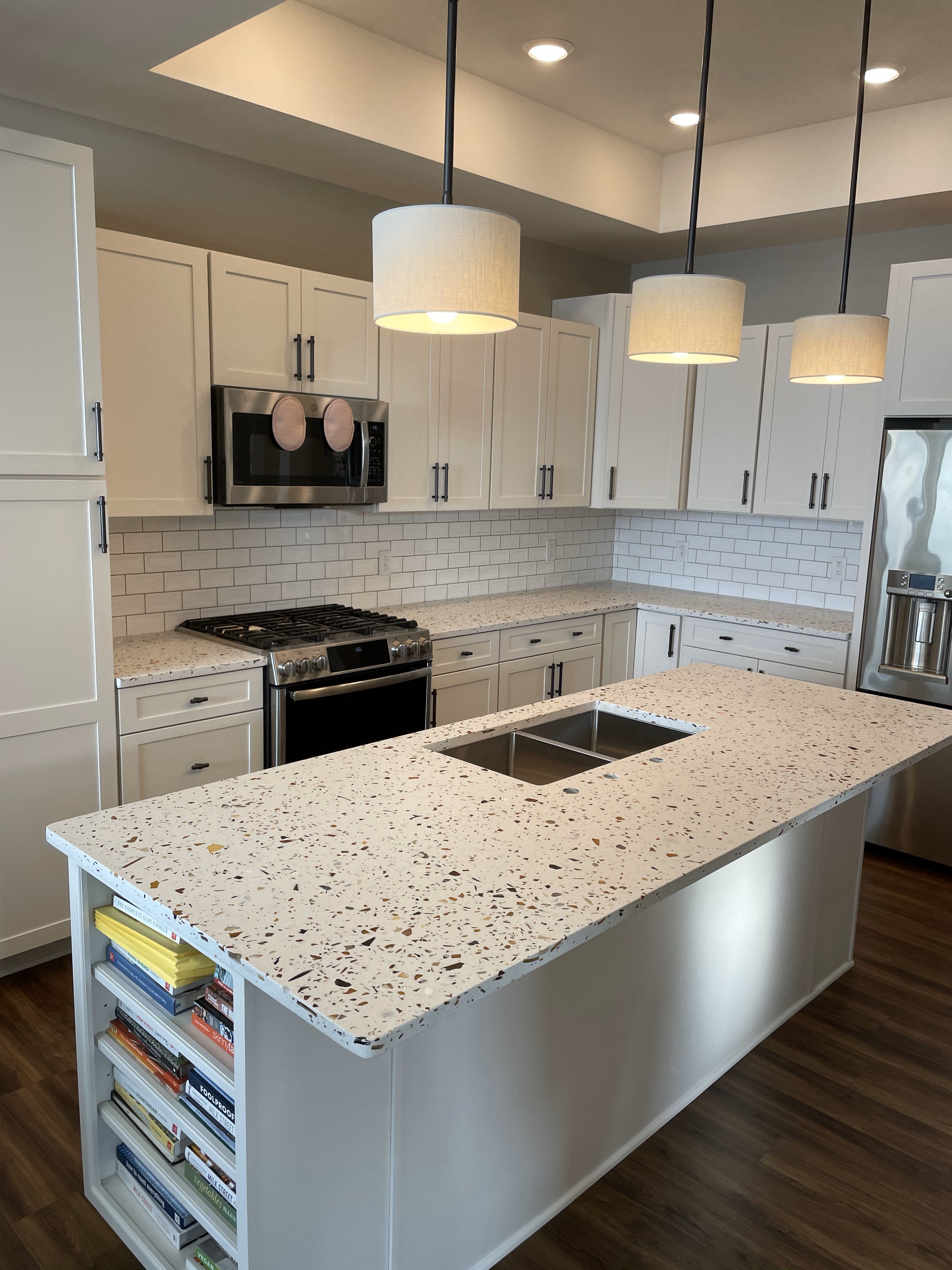
Quartz vs. Quartzite: The Architect’s Guide to Specifying the Right Surface (And When to Skip Both)
Quartz vs. Quartzite Summary
Looking for a quick comparison of quartz and quartzite? Look no further! There are pros and cons of each material, which we will outline below. Be aware that quartz companies will steer you toward quartz vs. quartzite, and there are reasons that quartz can outperform quartzite. There are distinct differences that should be understood before making a decision.
Quartz Benefits
- Available in a wide range of colors and patterns
- No pre-sealing or annual resealing required
- Stain resistant and durable
Quartz Drawbacks
- Popular colors and patterns are commonly used/not very unique
- More affordable brands may be of questionable quality
Quartzite Benefits
- Each surface is completely unique
- Some quartzite is translucent, allowing for unique backlighting
- Exclusive, high-end countertop material
Quartzite Drawbacks
- Requires pre-sealing and annual resealing with wax, poly, or acrylic sealant
- Porous and prone to stains
It’s the eternal question that inevitably derails every initial client meeting: “Wait, isn’t quartz the same thing as quartzite?”
As an architect or designer, you already know the short answer is a resounding no. But explaining the nuances of metamorphic rock versus engineered resin to a client who just wants a pretty kitchen island can be exhausting. Furthermore, with shifting supply chains, fluctuating tariffs, and a growing demand for genuinely sustainable materials, deciding which of these to specify—or if you should specify either of them at all—has become a surprisingly complex calculus.
Let’s skip the basic marketing fluff and break down the actual differences, benefits, and hidden liabilities of quartz and quartzite so you can specify with absolute confidence.
The Origin Story: Laboratory vs. Mother Nature
The fundamental difference between these two surfaces comes down to their genesis.
Quartz is an engineered surface. It is manufactured by taking pulverized natural quartz dust and binding it together with resins and pigments. Because it is made in a factory, its aesthetics are entirely dictated by market trends. Quartzite, on the other hand, is a naturally occurring metamorphic rock. It started its life as sandstone before extreme heat and tectonic pressure fused it into a dense, crystalline structure. It is cut directly from the earth into slabs.

The Specification Breakdown: Pros, Cons, and Reality Checks
Specifying Quartz
The Vibe: Predictable, high-performing, and trend-conscious.
-
The Benefits: Because of the resin binder, quartz is non-porous. It doesn’t require pre-sealing, it won’t need an annual wax, and it is highly resistant to stains. It is the reliable workhorse of the surfacing world.
-
The Drawbacks: It suffers from commoditization. The most popular veining patterns are ubiquitous—meaning your high-end commercial project might end up featuring the exact same countertop as the budget flip-house down the street.
-
The Industry Warning: Beware the cheap knockoffs. The market was recently flooded by low-quality quartz from overseas manufacturers cutting corners with sub-par resins, leading to domestic tariffs just to stabilize the industry. If you specify quartz, verify the supply chain.
Specifying Quartzite
The Vibe: Completely bespoke, prestigious, and demanding.
-
The Benefits: No two slabs are identical. While typically white or gray, trace minerals like iron can introduce stunning pink, red, or green hues. For high-end hospitality or luxury residential work, certain translucent quartzites can even be backlit for a jaw-dropping focal point.
-
The Drawbacks: It requires babysitting. Quartzite is microporous. It must be treated with a poly, wax, or acrylic sealant prior to installation, and your client must commit to resealing it annually. If they neglect it, it will stain.

The Plot Twist: What if the Answer is Neither?
Here is the reality of modern design: clients are increasingly demanding surfaces that are not just durable and beautiful, but inherently responsible.
If you want the matte warmth of natural stone without the maintenance, or the durability of engineered quartz without the questionable overseas resin binders, it is time to expand your materials library. At CaraGreen, we curate high-performance, sustainable alternatives made from diverted glass, recycled paper, and innovative eco-resins that outperform traditional options while securing those coveted LEED points.
Ready to specify something with a better story? Browse our full catalog of sustainable surfaces or request a quote for your active project today.

What is the main difference between quartz and quartzite?
Quartz is a man-made, engineered surface composed of pulverized quartz dust bound together by resins and pigments. Quartzite is a 100% natural metamorphic rock mined directly from the earth and cut into slabs.
Which is better for high-traffic commercial design: quartz or quartzite?
Engineered quartz is generally better suited for high-traffic commercial applications because its resin binder makes it non-porous, stain-resistant, and maintenance-free. Quartzite, while highly durable against scratching, is porous and requires strict, annual resealing to prevent permanent staining from spills.
Does quartzite need to be sealed?
Yes. Unlike engineered quartz, natural quartzite is microporous. It requires a professional-grade sealant (acrylic, poly, or wax) prior to installation, and must be routinely resealed every year to maintain its finish and resist liquid absorption.
Are there eco-friendly alternatives to quartz and quartzite countertops?
Absolutely. The architecture and design industry is rapidly shifting toward sustainable surfacing. High-performance alternatives include sintered stone (which is silica-free and highly durable), recycled paper composites, and recycled glass set in aeronautics-grade epoxy. These materials offer the aesthetic appeal of stone while diverting massive amounts of waste from landfills.
Share:
Sinter vs. Printer – How “sintered stone” differs from porcelain
Rethinking Terrazzo: 3 Sustainable Surfacing Alternatives for the Modern Architect